Is your SAP landscape ready when one QR code replaces every barcode on the box?
GS1 Sunrise 2027 turns many barcodes into one QR code on the box. For SAP customers running warehouse and distribution operations, it's a labeling change on the surface and an integration project underneath. Here's what changes inside SAP, what to check first, and why 2027 is closer than it sounds.

TL;DR
GS1 Sunrise 2027 commits retailers worldwide to scan 2D barcodes at point of sale by the end of 2027. For serialized goods like consumer electronics, the cluster of 1D barcodes on a box (GTIN, serial, IMEI, eSIM/EID and more) gets consolidated into a single GS1 Digital Link QR code.
On the packaging it looks elegant. Inside your SAP landscape it’s an integration project: goods receipt, inventory, picking and search must decode one URL into many fields; master data and validation logic must recognize GS1 Application Identifiers inside a URL rather than a plain numeric string; dual-marking of 1D and 2D will run in parallel for years.
A subtler consequence: once plain digits and 1D barcodes come off the box, the QR code becomes the only carrier of product identity. Every process step that confirms “is this the unit I think it is?” now needs a 2D-capable app. Steps that never needed a scanner before suddenly do.
On this page
What GS1 Sunrise 2027 actually is
The barcode is getting an upgrade, and it’s a bigger back-end project than the packaging makes it look.
Under GS1’s Sunrise 2027 initiative, retailers worldwide are committing to scan 2D barcodes (QR Code, GS1 DataMatrix) at point of sale by the end of 2027, alongside the 1D barcodes we’ve relied on since 1974. For consumer electronics and other serialized goods, the direction is clear: the cluster of separate 1D barcodes on a box, GTIN/UPC, serial number, IMEI, eSIM/EID and more, consolidated into a single GS1 Digital Link QR code. This creates real opportunities across the full supply chain and for the end customer.
Elegant on the packaging. Non-trivial in the systems behind it.
One code, many fields: where the work sits
That one QR code isn’t just a link. It’s a structured URL that carries each identifier tagged with a GS1 Application Identifier (AI): 01/02 for GTIN, 21 for serial, and so on. The scan now returns one string that has to be parsed into many fields. That’s where the work sits.
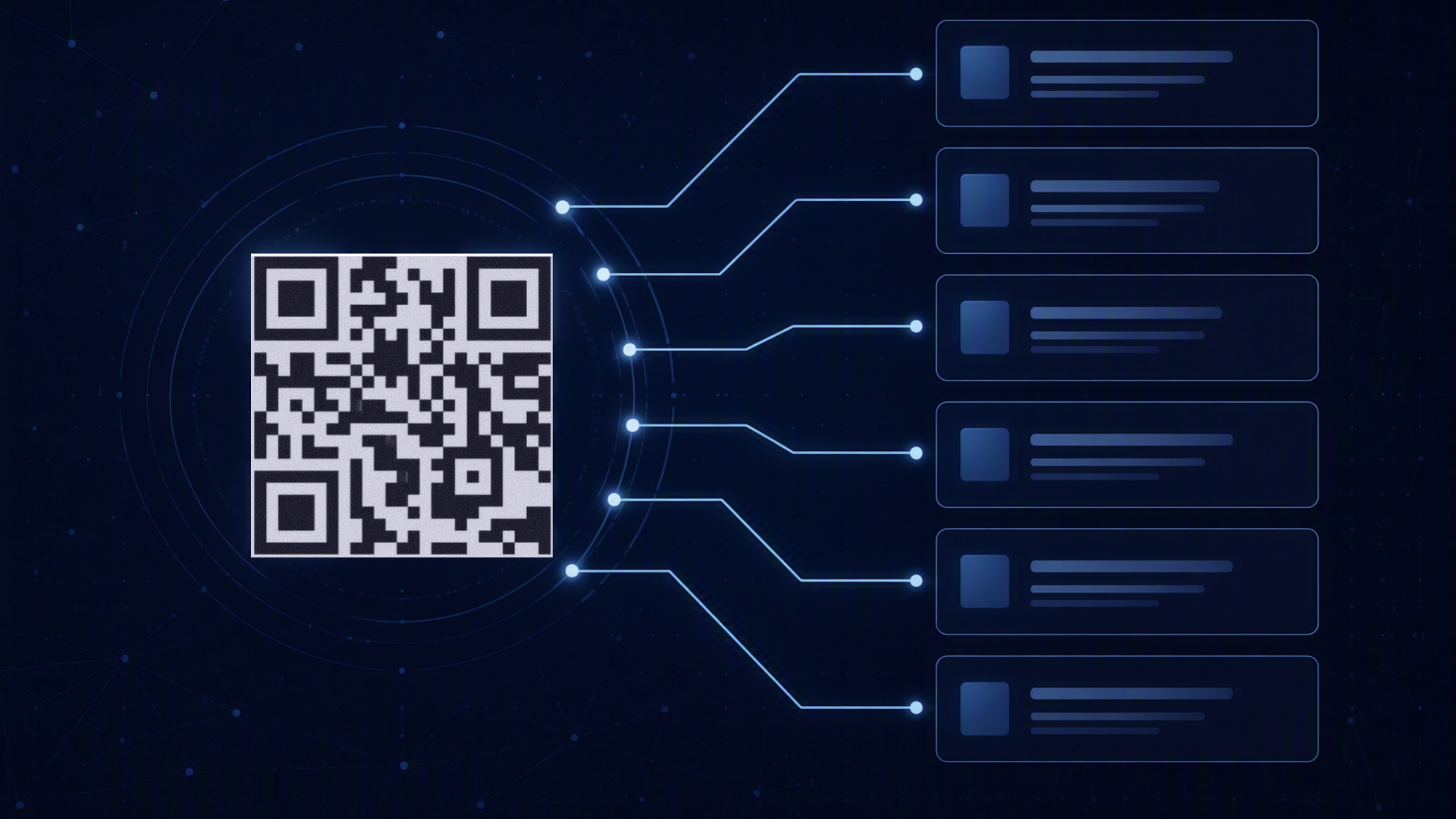
One GS1 Digital Link URL, many SAP fields to populate.
For distributors, retailers and service centers, this is not simply “buy new scanners.” It runs through the whole data chain:
- Scanning hardware must read 2D. Plenty of older 1D-only devices in warehouses can’t, and need replacing or upgrading.
- Goods receipt, inventory and picking systems must decode one code into multiple data elements: pull GTIN, serial, IMEI, eSIM, batch and more out of a single GS1 Digital Link URL and route each to the right field.
- Dual-marking is the reality for years. 1D and 2D will coexist on products through a long transition. Systems must handle both in parallel; there’s no clean cut-over.
- Parsing logic must be product-aware. A serialized phone, a non-serialized accessory and a laptop carry different AI combinations. The middleware has to cope with all of them.
The subtler consequence: identity moves into the QR
When the plain digits and 1D barcodes come off the box, the QR code becomes the only carrier of the GTIN, serial, IMEI, batch and the rest. There’s no human-readable number left to eyeball. So every process step that depends on confirming product identity, picking verification, returns, repair intake, quality checks, spot audits, now needs a 2D-capable app just to answer “is this the unit I think it is?” Steps that never needed a scanner before suddenly do.
Where it lands in SAP
From an SAP standpoint this lands squarely in inbound processing, internal movements, inventory, picking, searching etc. It means capturing and splitting the GS1 Digital Link payload in several processes, plus master-data and validation logic that recognizes GS1 AIs inside a URL rather than a plain numeric string. It’s a labeling change on the surface and an application change underneath.
Some producers will skip the 1D barcodes and only apply 2D barcodes to their products in the near future.
2027 sounds far off. It isn’t.
For anyone who has scoped a scanner rollout plus WMS changes and adjacent SAP process changes across a distribution network, it isn’t. The lead time on hardware, on integration work, on parallel-run testing across dual-marked inventory, adds up fast. Producers who move to 2D-only sooner will force the timeline whether you’re ready or not.
Is your warehouse landscape ready to read one code and understand many?
— Terje
Is your SAP warehouse landscape ready for one code, many fields?
Book a free 2-hour readiness conversation. We map which of your warehouse scanning devices and WMS processes are 2D-ready today, where GS1 Digital Link parsing will land inside your SAP landscape, and what a phased rollout looks like before 2027. Fixed scope. No sales pitch. You leave with a fact base you can act on.
FAQ
What is GS1 Sunrise 2027?
It’s a global GS1 initiative committing retailers to scan 2D barcodes (QR Code, GS1 DataMatrix) at point of sale by the end of 2027, alongside the 1D barcodes in use since 1974. For serialized goods, it enables consolidating GTIN, serial number, IMEI, eSIM/EID and other identifiers into a single GS1 Digital Link QR code.
Do we need to replace all our scanners?
Only the 1D-only ones. Any scanner already reading 2D symbologies (QR, DataMatrix) is fine. The bigger cost is usually the older devices in warehouses that can’t read 2D at all, plus any handheld apps used for picking, returns or repair intake that assumed a plain numeric string.
What changes inside SAP?
Goods receipt, inventory and picking logic must decode one GS1 Digital Link URL into multiple data elements and route each to the right field: GTIN, serial, IMEI, batch and so on. Master data and validation logic need to recognize GS1 Application Identifiers inside a URL rather than a plain numeric string. In practice, it touches inbound processing, internal movements, inventory, picking and search.
Can we keep 1D and 2D barcodes running in parallel?
Yes, and you’ll have to. Dual-marking is the reality for years. Products will carry both symbologies through a long transition, and some producers will move to 2D-only sooner than others. Systems must handle both in parallel; there’s no clean cut-over.
Why can’t we just wait until 2027?
Because scoping a scanner rollout plus WMS and adjacent SAP process changes across a distribution network is a multi-quarter programme, not a switch. Once plain digits and 1D barcodes come off the box, the QR code becomes the only carrier of product identity in the future. Every process step that confirms “is this the unit I think it is?”, picking verification, returns, repair intake, quality checks, spot audits, needs a 2D-capable app. Steps that never needed a scanner before suddenly do for the products that only have 2D barcode.
What’s the first thing to check?
Two questions. One: which of our scanning devices across warehouse operations can already read 2D, and which can’t? Two: where in our SAP processes do we today rely on a plain numeric identifier that will, in future, arrive embedded inside a GS1 Digital Link URL? That gives you the scope of the integration work.
