Has your SAP estate become leverage, or is it still just invoices you cannot question?
Since 9 July, six SAP commitments are legally binding for ten years. What does it mean for your Nordic SAP estate, and how do you use the leverage before your next renewal?
TL;DR
On 9 July 2026, the European Commission made six SAP commitments legally binding for ten years, worldwide, under independent trustee supervision. It is a commitments decision, not a guilty verdict, but the commitments themselves are hard law.
Nordic SAP customers can now split their landscape and choose support per part, terminate unused licenses and maintenance in defined circumstances, avoid reinstatement fees, and stop new purchases from restarting the lock-in clock. The gray areas are where the real work sits: which terminations qualify, where the boundary of a “part” runs, what happens to bundled discounts.
The prize is not a discount at renewal. It is a reshuffle: delete what no longer earns its place in the SAP stack, keep the core where SAP is genuinely best, redirect freed-up spend to modern integration, agent-ready data, and agentic AI. Every SAP customer in the Nordics has more leverage today than in June. Few have mapped it. Fewer have used it.
On this page
What the European Commission actually decided
On 9 July, the European Commission made six commitments from SAP legally binding. Ten years. Worldwide. An independent trustee watching over compliance.
To be precise about what this is: a commitments decision, not a guilty verdict. SAP admits nothing, and the Commission’s concerns stay preliminary. But the commitments themselves are hard law for the next decade, and they change what you can do with your SAP estate.
The discipline was never the problem
For years we have run one law at S5: nothing gets automated until it has survived deletion. Question the requirement. Delete what fails the test. Then simplify, accelerate, automate, in that order. The discipline was never the problem. The problem was that the commercial terms punished deletion. You could retire the system, but the maintenance bill lived on.
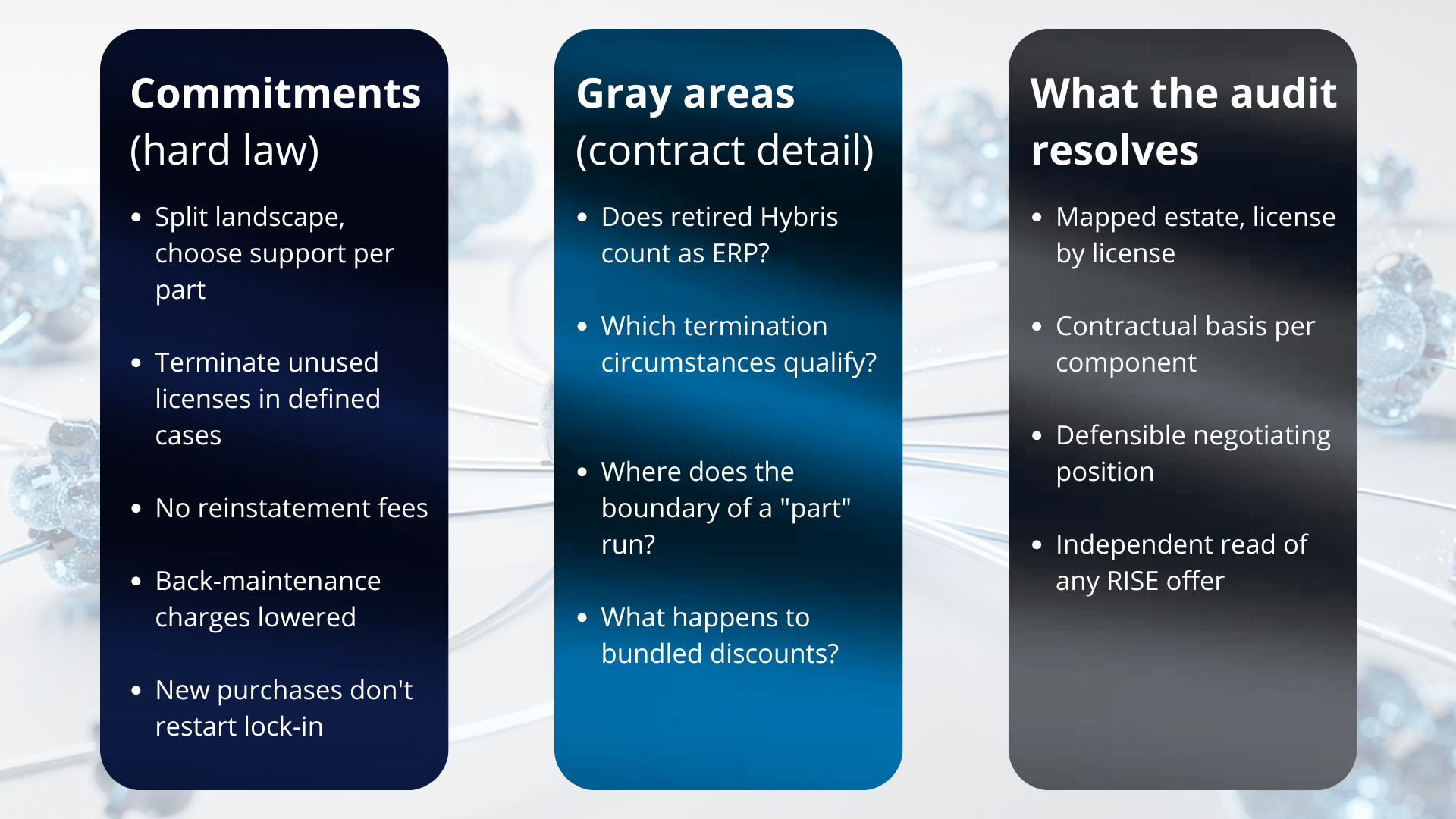
That is what changed. You can now split your landscape and choose support per part, SAP, third party, or none. You can terminate unused licenses and their maintenance in defined circumstances. Reinstatement fees are abolished, and back-maintenance charges are lowered. New purchases no longer restart your lock-in clock.
Read that middle sentence again: in defined circumstances. That is where the real work starts.
The gray areas are the terrain
The decision covers maintenance and support for SAP on-premises ERP software. Sounds clear. It isn’t. Take a customer we all recognize: bought Hybris years ago for the webshop, has since moved commerce off the SAP stack entirely, commercetools, Optimizely, something built for how they actually sell. The webshop is gone. The maintenance invoice is not. Does a retired Hybris installation count as “ERP software” under the decision? Arguable. SAP will read the scope narrowly. You should read your support agreement carefully, because when Hybris sits under the same umbrella agreement as your ECC estate, the question of what you can carve out, terminate, or renegotiate is a matter of contract detail, not headlines. That is one gray zone. There are more: which termination circumstances your licenses actually qualify for, where the boundary of a “part” of your landscape runs when you want to split support, and what happens to bundled discounts when you start pulling components out.
This is exactly where the leverage sits. Gray areas cut both ways. SAP’s account team will resolve every ambiguity in SAP’s favor, that is their job. Most customers walk into that conversation with a headline and a hope. The ones who win walk in with a mapped estate: every license, its usage, its contractual basis, and a defensible position on what the commitments now permit. The decision didn’t hand you the outcome. It handed you the negotiating position.
The reshuffle is the prize
Renegotiating for a discount is thinking too small. This is the window to redesign: take out what no longer earns its place in the SAP stack, keep the core where SAP is genuinely best, and redirect freed-up spend to where the returns are right now, modern integration, data that is agent-ready and not just report-ready, and agentic AI on SAP’s Business AI Platform (BAIP, the platform formerly known as BTP) or on Azure, whichever fits your landscape. And a keep-side example matters just as much: you want S/4HANA on-premises with the hosting partner you trust, not RISE, with BAIP and Azure on top for innovation. The commitments make that architecture contractually cleaner than it has ever been. Automation applied to something that shouldn’t exist locks the waste in. Delete first. Then build.
Where we fit
Three things, in order. First, the audit: map what you own, what you use, what you pay, and which commitments apply, including the honest answer when something falls in a gray zone. Second, the strategy: what to delete, what to keep, what to move, and what the freed-up budget should build. Third, the negotiation: a fact-based position for your next renewal, from people with no horse in the race. Expect SAP to answer this decision with more aggressive RISE offers. Some will be good. Some will be lock-in with a discount attached. We will tell you which is which, even when the answer is “take SAP’s offer.”
Every SAP customer in the Nordics has more leverage today than in June. Few have mapped it. Fewer have used it.
You know where to find us.
— Sveinung
Source: European Commission press release, 9 July 2026.
Has your SAP estate become leverage, or is it still just invoices you cannot question?
Book a free 2-hour SAP estate audit conversation. We map what you own, what you use, what you pay, and which of the six commitments apply to your contracts. Fixed scope. No sales pitch. You leave with a fact base you can act on before your next renewal.
FAQ
Was SAP found guilty by the European Commission?
No. The 9 July 2026 outcome is a commitments decision, not a guilty verdict. SAP admits nothing, and the Commission’s concerns stay preliminary. But the six commitments SAP made are legally binding for ten years, worldwide, under independent trustee supervision. The distinction matters when you sit across from your SAP account team.
Which commitments apply to my SAP estate specifically?
The decision covers maintenance and support for SAP on-premises ERP software. Which parts of your estate qualify depends on contract detail: what your umbrella agreement says, how components are bundled, and whether specific licenses meet the termination circumstances the commitments define. An audit maps this precisely for your contracts, not for the category.
Can I terminate maintenance on Hybris if we moved commerce off SAP?
It is a gray zone. The decision covers ERP software, and whether a retired Hybris installation counts as ERP under the scope is arguable. SAP will read the scope narrowly. Your position depends on how Hybris sits in your umbrella agreement relative to your ECC or S/4HANA estate. This is exactly the kind of question the audit is designed to answer.
What happens to my bundled discounts if I terminate parts of the estate?
It depends on how the bundle is written. Some bundled pricing survives partial termination. Some collapses back to list price on the remaining components, which can wipe out the savings from what you terminated. This is one of the highest-value questions the audit resolves, because getting it wrong turns a leverage moment into a cost increase.
Is this a good time to accept a RISE offer?
Sometimes yes, sometimes no. Expect SAP to answer the decision with more aggressive RISE offers. Some will be genuinely good. Some will be lock-in with a discount attached. The difference sits in the contract terms, not the headline number. We give an independent read on any RISE offer on the table, and when the answer is take it, we say so.
How long do I have to act on this leverage?
The commitments run for ten years, so the framework is durable. Your window is not. Leverage is spent at your next SAP renewal: once the contract is signed, the pricing and scope are locked for the term. Customers renewing within 12 months are the priority.