SAP Integration Platform Strategy in 2026: How to Choose Between SAP Integration Suite, Azure, and Frends
Most SAP customers treat the integration platform as a sub-decision of ERP. That is a mistake — and an expensive one. This guide compares the three credible options, maps them to your ERP state, and gives you the seven questions that determine which fits.
TL;DR
SAP customers in 2026 face two strategic platform decisions — not one. Everyone focuses on the ERP question (S/4HANA, RISE, Grow, or stay). The integration platform decision sits right next to it and is just as consequential — but it almost always gets deferred.
The three serious options are SAP Integration Suite (strongest inside the SAP domain), Microsoft Azure (strongest as a cloud, data, and AI platform), and Frends (strongest as a manageable, focused integration layer — standalone or on top of Azure). Most enterprise customers need more than one.
The standard PI/PO end-of-maintenance date is December 2027. Extended maintenance is available until 2030 — which buys time, but not unlimited time. The right move is to use that window deliberately: migrate the integrations that matter most now, and sequence the rest. Don’t let the 2030 option become another deferral.
S5 Consulting delivers across all three platforms. We are transparent about our Frends partnership. We do not resell SAP licences.
Table of Contents
- Is your integration platform decision being treated as a sub-decision of ERP?
- Why integration strategy is now a board-level decision
- The three credible SAP integration platforms in 2026
- How your ERP state shapes integration platform fit
- The three hybrid patterns that work in practice
- S5’s productised PI/PO migration
- Seven questions to answer before you choose
- Why S5 for SAP integration strategy
- Frequently asked questions
Is your integration platform decision being treated as a sub-decision of ERP?
It should not be. But in most SAP programmes, it is.
The ERP question gets the boardroom. The integration question gets a workstream. And by the time the ERP roadmap is agreed, the integration platform has already been chosen — usually by default, usually in favour of whoever had the best slides in the room.
Here is what that costs you: two to three years of accumulated integration debt while you wait. A PI/PO landscape that nobody wants to operate past 2027. And an integration architecture inherited from a forced decision rather than a deliberate one.
The cleaner approach is to treat ERP and integration as two parallel decisions:
- Where is our SAP ERP landscape going?
- What integration architecture do we need — regardless of where the ERP lands?
This article gives you the structured, vendor-honest framework to answer the second question.
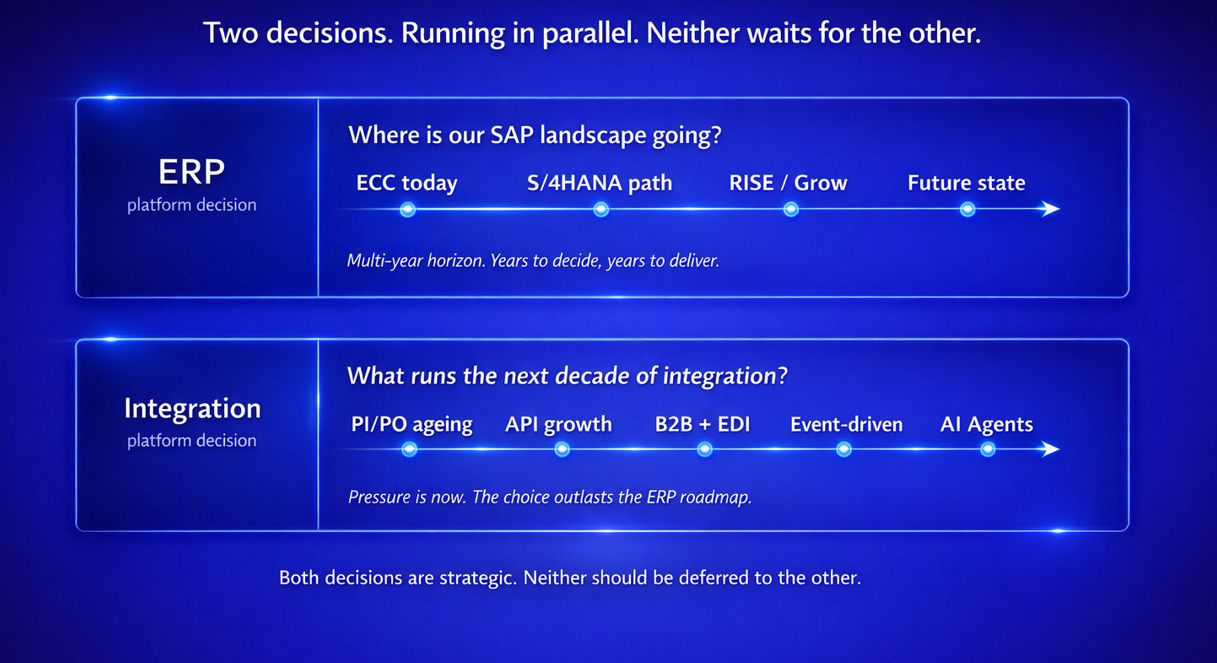
The ERP journey is measured in years. Integration pressure is now — the choice outlasts the ERP roadmap
Why integration strategy is now a board-level decision
Integration has historically been treated as plumbing: invisible when it works, catastrophic when it breaks. That framing is no longer adequate.
Three forces have elevated integration platform strategy to the top of the SAP technology agenda in 2026:
PI/PO end-of-maintenance (2027 for most customers). The legacy middleware that most SAP landscapes were built on is approaching end-of-life. Standard maintenance ends December 2027. Extended maintenance is available until 2030 — but it is not a free pass. The extended window is best used to migrate the highest-value integrations first, reduce PI/PO footprint deliberately, and avoid a forced rewrite under pressure in 2029.
What we increasingly see in practice is not a hard cutover — but a controlled dual-runtime phase. For many SAP customers, a pragmatic approach is to run PI/PO alongside SAP Integration Suite (or another target platform) for a defined transition period. This allows organisations to stabilise S/4 migrations, externalise logic gradually, and avoid forcing high‑risk rewrites under time pressure. In well-governed landscapes, this dual setup can extend beyond the initial migration window — in some cases approaching the end of the decade — provided there is a clear plan for decommissioning and no net-new strategic investment on PI/PO.
Event-driven and AI architectures. A single business event — an order, a delivery, a maintenance alert — now triggers reactions across five to ten systems simultaneously. Traditional request/response integration cannot handle this at scale.
Clean Core and S/4HANA migration. Moving to S/4HANA requires externalising custom logic. That logic has to live somewhere — and the integration platform is part of where it goes.
The result: integration platform selection is no longer a sub-decision of the ERP programme. It is a parallel strategic decision with its own timeline, its own business case, and its own risks if deferred.
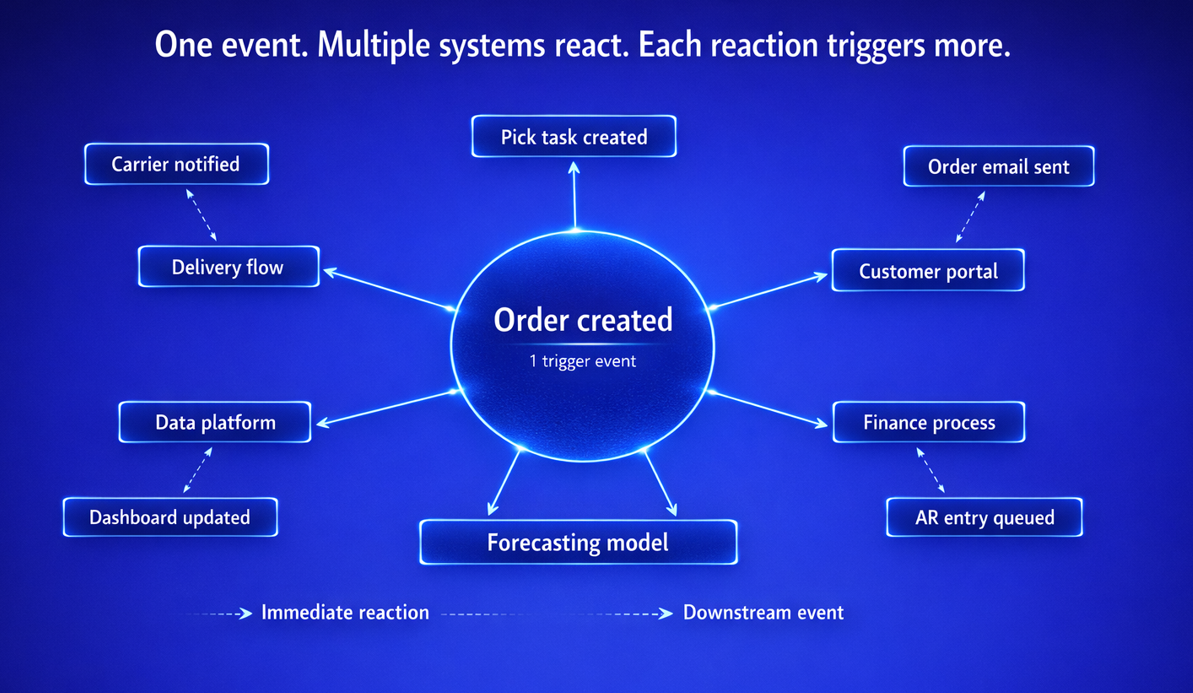
Traditional request/response integration was not built for this — one trigger event now fans out across five to ten systems simultaneously
The three credible SAP integration platforms in 2026
For SAP ERP customers, the market has consolidated around three serious options. Each is credible. None is right for every customer.
SAP Integration Suite
SAP Integration Suite is the natural home for integration that lives inside the SAP domain: SAP-to-SAP flows, Clean Core extensions, SAP cloud application integration (SuccessFactors, Ariba, Concur), and prebuilt SAP content packages. For RISE and Grow customers, it is often part of the default architecture.
Its strengths are deep SAP content, native alignment with the SAP roadmap, and tight integration with BTP.
The risk is scope creep: SAP Integration Suite gets introduced through the smallest available footprint and then expected to cover production integration volumes, B2B flows, EDI, and non-SAP orchestration where the chosen edition is often not optimised for that scope.
The right question is not “Can we start small with SAP Integration Suite?” It is: “What does our integration estate actually look like at production scale in three years — and is SAP Integration Suite the right platform for that full scope?”
Microsoft Azure Integration Services
Azure is not a single integration product — it is a cloud architecture platform with strong integration services embedded in it: Logic Apps, Azure Service Bus, Event Grid, Event Hubs, API Management, Azure Functions, Data Factory, and Microsoft Fabric.
Its strength is breadth and ecosystem alignment. For SAP customers moving toward Microsoft Fabric for data, Azure OpenAI for AI workloads, or Copilot Studio for process automation — Azure is a compelling choice.
Its challenge is that breadth creates complexity. Azure integration landscapes require strong governance discipline. Without it, they drift into sprawling Logic App estates with inconsistent error handling and unclear ownership. Power and manageability are not the same thing. For organisations already standardising on Microsoft Fabric, identity, and AI, Azure often becomes the integration backbone — whether it is formally declared or not.
Frends
Frends is a focused iPaaS built for customers who want the integration layer itself to be manageable — not assembled from cloud-native primitives. It is particularly strong for PI/PO replacement, B2B and EDI scenarios, file-heavy flows, hybrid execution environments, and long-running processes.
Frends is not an Azure competitor or an Azure add-on. It occupies a different position: it is the dedicated integration orchestration layer — either as a standalone platform for customers who do not need Azure, or as the integration layer inside an Azure-based architecture for customers who want to keep that layer manageable without re-engineering every flow from Azure primitives.
S5 is a Frends partner. We are transparent about that because hiding a partnership is not how trust gets built — and because we work across all three platforms and only recommend Frends where it genuinely earns its place.
How your ERP state shapes integration platform fit
The right integration platform is not independent of your SAP ERP state. The table below maps the most common ERP configurations to platform fit — based on what we see working in production at Nordic SAP customers.
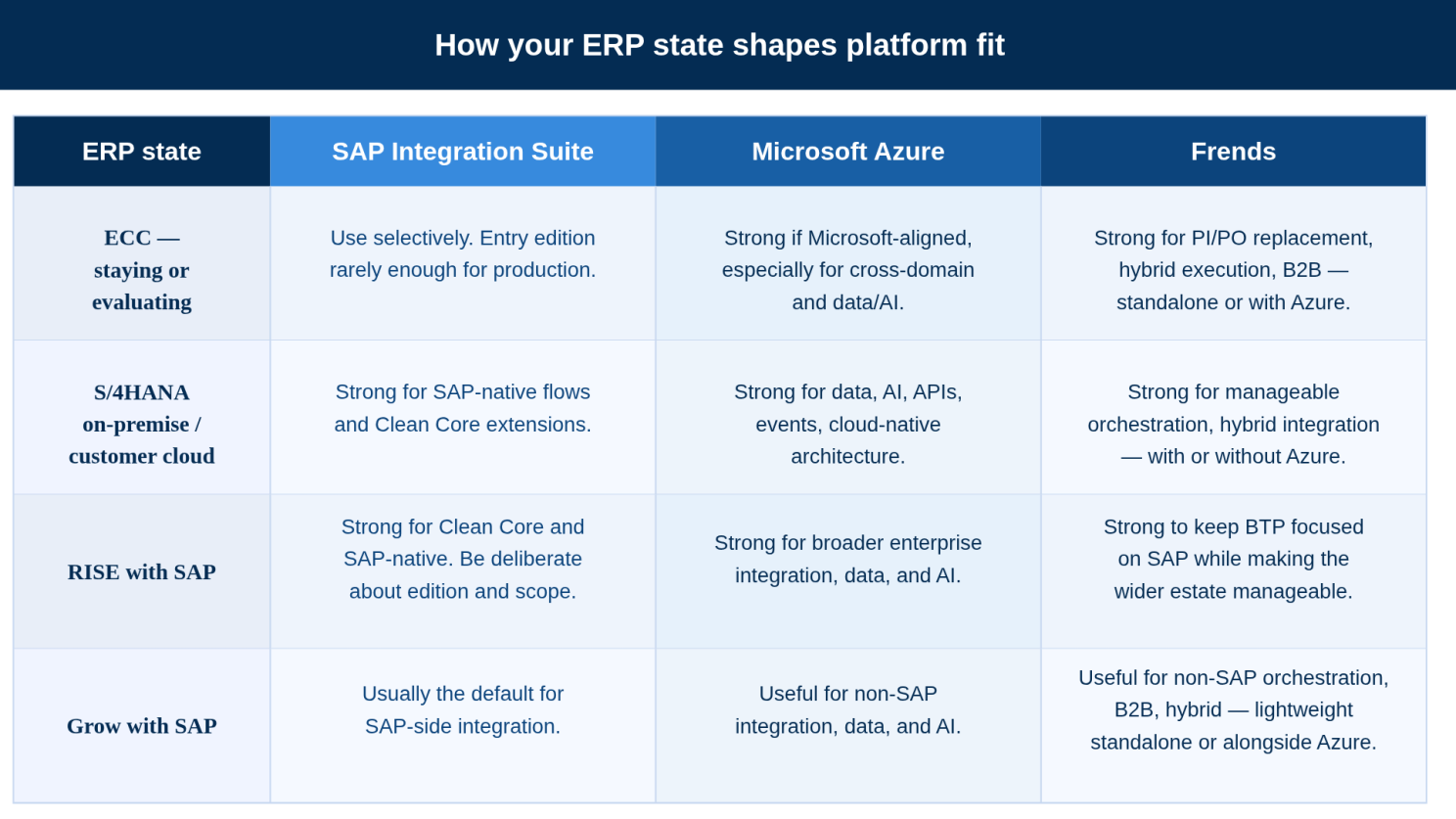
The more SAP manages the ERP core, the more deliberate you must be about everything outside that core — including where integration sits.
The three hybrid patterns that work in practice
Very few SAP enterprise customers run a single integration platform across their entire estate. The question is not whether to use multiple platforms — it is which combination to use, and how to govern the boundaries.
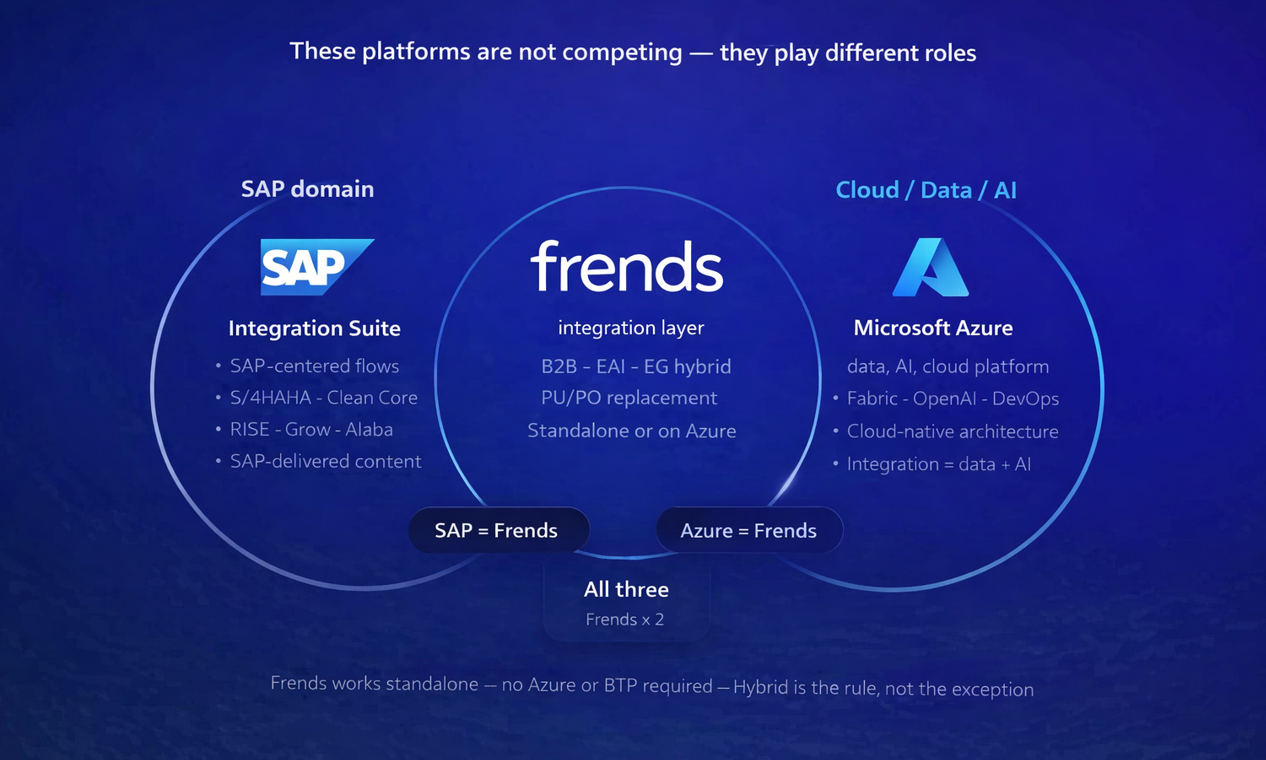
Frends sits at the intersection — working alongside SAP Integration Suite, alongside Azure, or as a standalone orchestration layer
Pattern 1: SAP Integration Suite + Azure
The natural fit for SAP-heavy enterprises with a mature Microsoft strategy. SAP Integration Suite handles SAP-native and Clean Core flows. Azure handles cross-domain APIs, the data platform, AI workloads, and broader enterprise architecture. Works well when the organisation has the engineering discipline to govern Azure integration directly.
Pattern 2: Frends + Azure + selective SAP Integration Suite
A pattern more SAP customers we work with are starting to consider seriously. Azure carries data, AI, identity, DevOps, and event services. Frends handles day-to-day integration orchestration, B2B, EDI, file-heavy and long-running flows. SAP Integration Suite is used selectively for SAP-native scenarios where it genuinely earns its place. The result is a layered architecture where each platform is doing what it does best.
Pattern 3: Frends standalone + SAP Integration Suite (light)
The right fit for customers who want clean SAP-native integration via SAP Integration Suite where it makes sense, but do not want to route their entire estate through BTP — and do not need Azure as the primary platform. Frends carries the rest. Simpler to operate, faster to implement, and lower total cost for customers whose integration estate is not deeply cloud-native.
S5’s productised PI/PO migration: the most urgent decision first
For many SAP customers, the most urgent integration question is not which platform to standardise on long-term — it is how to use the PI/PO maintenance window wisely. Standard support ends December 2027; extended maintenance runs to 2030. The productive use of that window is to identify which integrations carry the most business value and migrate those first — not to treat 2030 as the new deadline and defer everything.
S5 has productised this decision. Our PI/PO migration offer: Typically delivered in ~3 months, with high automation and a fixed commercial model. Delivered with TheValueChain. We have run it before, and we will run it again next month. → See our PI/PO migration offer
The migration is platform-agnostic at intake: we assess your landscape in a free 2-hour discovery call and tell you which target platform fits your ERP state, your B2B footprint, and your future operating model. Then we deliver.
Free 2-hour discovery — no follow-up pressure
Seven questions. Honest answer. We tell you which platform fits your situation — or whether none of the three is right for you. Talk to Sveinung Gehrken or a senior integration architect before you talk to any platform vendor.
Seven questions to answer before you choose
These are the questions that determine platform fit in practice. They are also the questions we work through in every integration posture review.
- What integration belongs inside the SAP domain? Not every flow needs to be SAP-owned. External APIs, B2B, non-SAP SaaS, and high-volume orchestration may not belong in SAP Integration Suite.
- What belongs in Azure? Your integration choices should reinforce your Azure investment without turning every integration into a custom Azure engineering project.
- Where would Frends make the integration layer more manageable? If faster setup, easier governance, hybrid runtime, B2B and EDI support, or reduced dependency on cloud specialists matter — Frends belongs on the shortlist.
- What will your integration profile look like in three to five years? Model API growth, event fan-out, B2B traffic, and AI agent calls. Future-state volumes change platform fit significantly.
- What is your real tolerance for variable cost models? Evaluate total cost of ownership against realistic future usage, not entry-level list pricing.
- Where is your integration engineering talent? Forcing the wrong team onto the wrong platform is a tax you pay every day.
- What operating model can you actually run? Integration strategy succeeds or fails in the operating model, not the tool selection.
If you are still running PI/PO or planning an S/4HANA or RISE transition, the integration decision should move in parallel — not follow behind it.
Why S5 for SAP integration strategy
S5 Consulting is an employee-owned SAP and enterprise technology consultancy headquartered in Lysaker, Norway, with operations in Sweden and Poland. AAA-rated. No offshoring. No licence resale. No vendor-incentive baggage.
We deliver across SAP ECC, S/4HANA on-premise, RISE with SAP, and Grow with SAP. We advise on integration platform strategy across SAP Integration Suite, Microsoft Azure, and Frends. We have 30+ integration projects across 14 named Nordic accounts since 2017 — including:
- Power International — headless commerce architecture on SAP BTP (ongoing)
- Modino AS — 9-year S/4HANA integration partnership, Azure EDIFACT, B2B
- Coop Norge — BizTalk-to-Azure migration, NLP and process automation
- Gyldendal — SAP to Microsoft Dynamics 365 CRM on BTP Integration Suite
We are transparent about our Frends partnership because the alternative is not advice — it is a sales pitch. We work across all three platforms and only recommend Frends where it genuinely earns its place.
Giving good advice is one thing. Being able to deliver that advice — at quality, on budget, in the customer’s real environment — is the hard part. A recommendation that cannot be executed is not advice.
Frequently asked questions
Is SAP Integration Suite included in RISE with SAP?
SAP Integration Suite is available as part of RISE with SAP, but the edition included in the base contract is not always sufficient for production integration at enterprise scale. The entry edition covers basic SAP-to-SAP scenarios. B2B, high-volume API management, and advanced event streaming typically require a higher edition. Always validate your RISE contract against the integration volumes you will actually run in production.
Can Frends replace PI/PO directly?
Yes. Frends is one of the two primary targets we use for PI/PO migration at S5 — alongside SAP Integration Suite. Frends is particularly well-suited for customers with large B2B, EDI, or file-based integration estates, hybrid deployment requirements, or teams that want faster time to production without deep BTP expertise. Our productised PI/PO migration typically delivered in ~3 months, with high automation and a fixed commercial model.
What is the difference between SAP Integration Suite and SAP BTP Integration Suite?
They are the same product. SAP Integration Suite runs on SAP Business Technology Platform (BTP). The full name is SAP Integration Suite on BTP. In market usage, the terms are used interchangeably. The key distinction is the edition: starter, standard, and premium editions have meaningfully different capability and pricing profiles.
How does Microsoft Azure Integration Services compare to SAP Integration Suite?
They are not competing products in the traditional sense — they are designed for different architectural roles. SAP Integration Suite is optimised for SAP-centered integration with deep prebuilt content. Azure Integration Services (Logic Apps, Service Bus, API Management, Event Grid) is optimised for cross-domain, cloud-native, data, and AI scenarios. Most enterprise SAP customers with a Microsoft strategy use both, with governance rules that define which platform owns which integration type.
Should we decide on the integration platform before or after the ERP decision?
In parallel, not after. Waiting for the ERP decision to finish means deferring PI/PO replacement, living with an ageing integration estate for another two to three years, and potentially making the ERP migration harder by accumulating more integration debt during the wait. The integration architecture informs the ERP business case — they are connected decisions that should run on connected timelines.
What does S5 charge for an integration posture review?
The initial 2-hour discovery call is free. We use it to assess your integration landscape, your ERP state, and your operating model, and to tell you which engagement tier fits — or whether none of them do. The Integration Posture Review (our first paid engagement) runs two weeks at a fixed price, scoped during the discovery call. Each engagement stands alone — you are not committed to the Architecture and Roadmap stage until you decide to proceed. No staircase pricing.
How does S5 handle vendor bias given your Frends partnership?
We are partners with Frends and transparent about it. We work across SAP Integration Suite, Microsoft Azure, and Frends, and recommend based on what fits the customer’s ERP state, operating model, and future architecture — not what generates the most partner revenue. We do not resell SAP licences. Our business model is advisory and delivery, not licence margin.